
Through these living agreements, Modern Treaty Nations exercise self-government, land ownership, and law-making authority within Canada’s constitutional framework. Modern Treaty Nations are sophisticated governments with the capacity, knowledge, and law-making authority to govern effectively. Their leadership draws on generations of experience, strengthened by modern governance practices, and is upheld by constitutionally protected treaty rights that ensure their decisions carry lasting strength and recognition.
Modern treaties are constitutionally protected, tripartite agreements between Indigenous Nations, Canada, and provinces/territories that combine comprehensive land claims with self‐government arrangements to structure long‐term nation‐to‐nation relationships. Modern Treaty Nations hold rights, titles, and jurisdictions that distinguish them from municipalities, First Nations without modern treaties, and Bands governed under the Indian Act. Their authority is grounded in clearly defined and recognized treaty rights protected by the Constitution. This distinction establishes Modern Treaty Nations as fully recognized governments within Canadian federalism, with the powers, responsibilities, and autonomy to govern their lands, citizens, and futures.
Modern treaties do not grant new rights. They recognize, affirm, and clarify Indigenous rights that have always existed and pre-date Canada. Through these living agreements, Modern Treaty Nations exercise self-government, land ownership, and law-making authority within Canada’s constitutional framework. Modern Treaty Nations are sophisticated governments with the capacity, knowledge, and law-making authority to govern effectively. Their leadership draws on generations of experience, strengthened by modern governance practices, and is upheld by constitutionally protected treaty rights that ensure their decisions carry lasting strength and recognition.
For more information on Modern Treaty Nations, visit the Resource Hub or learn more in our Frequently Asked Questions.
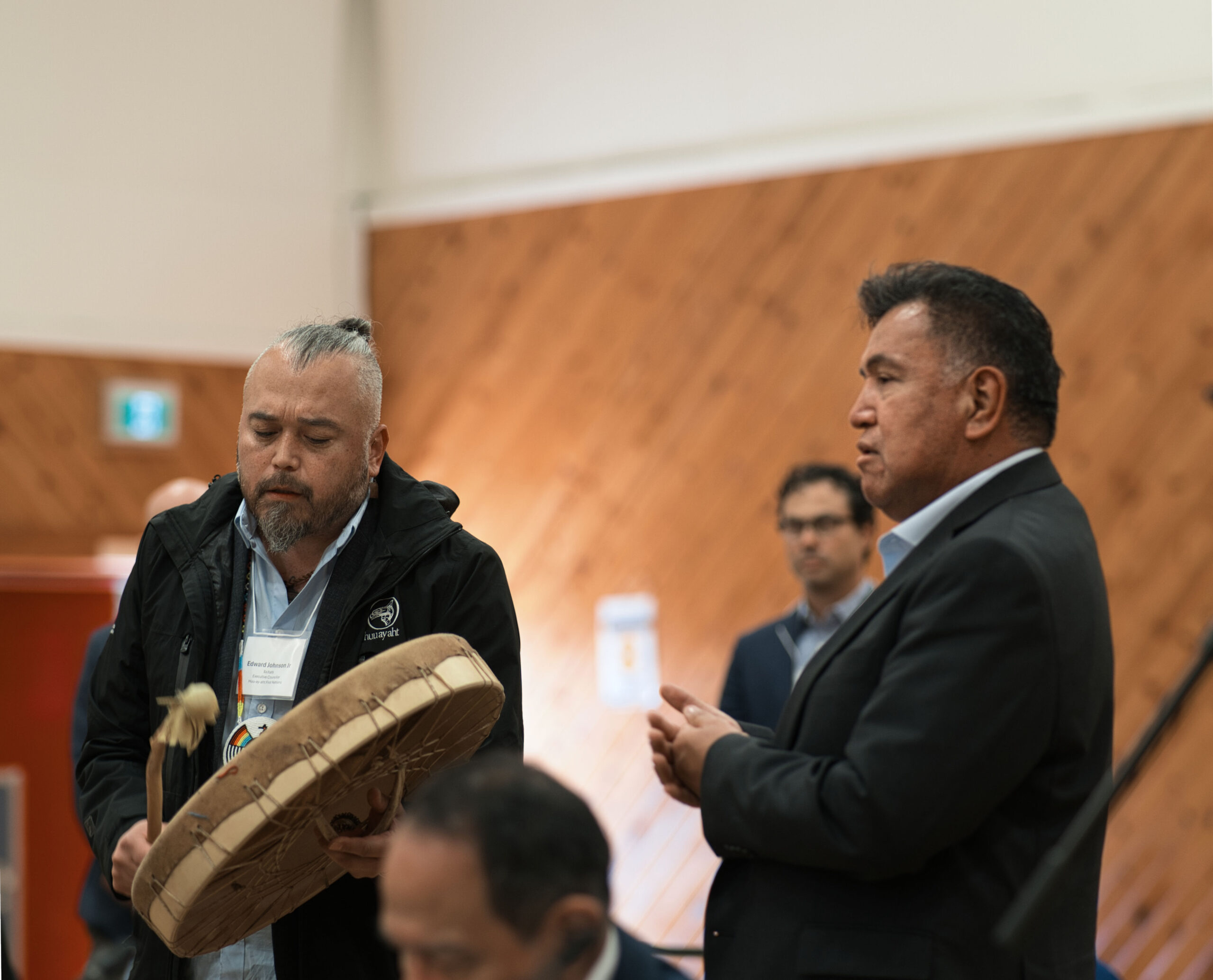
A modern treaty is a tripartite agreement between a First Nation, Canada, and the Province that recognizes a First Nation as a self-governing Indigenous government with constitutionally protected rights. These comprehensive living agreements combine land claims with self-government arrangements, removing Nations from the Indian Act and establishing their own constitutions and law-making powers over governance, land, and resources. Modern treaties are a symbol of stability and self-determination, and provide the certainty and confidence needed to move forward together. Modern Treaty Nations bring a depth of knowledge, leadership, and authority to the table, drawing on both traditional wisdom and modern structures to model a sustainable approach to self-determination.
British Columbia is home to eight Modern Treaty Nations, each bringing a depth of leadership, innovation, and governance expertise to the province. As of December 2025, three more First Nations have ratified their treaties and will become Modern Treaty Nations over the coming years, with an additional 54 First Nations actively negotiating modern treaties in B.C. This growing momentum demonstrates that modern treaties represent the way forward for Indigenous governance and reconciliation in B.C.
For more information on upcoming modern treaties, visit the BC Treaty Commission website.
Modern Treaty Nations strengthen the province by advancing reconciliation, demonstrating Indigenous self-government, and generating social and economic benefits that ripple across regions.
Their clarity of authority and capacity for long-term planning give communities, governments, and investors the confidence to pursue economic development, supporting a more stable, prosperous, and collaborative future for everyone in B.C.
The eight Modern Treaty Nations in B.C. are:
The Government of Canada passes the British Columbia Treaty Commission Act, establishing the BCTC.

1995
1998
Nisg̱a’a membership votes to ratify the Final Agreement and adopt the Nisg̱a’a Constitution.
The Nisg̱a’a Treaty (first modern treaty in BC, negotiated independently outside of the BCTC framework) comes into effect after receiving provincial Royal Assent on April 26, 1999, and federal Royal Assent on April 13, 2000.
2000
2007
Tsawwassen membership votes to ratify the Tsawwassen First Nation Constitution Act and Tsawwassen First Nation Final Agreement.
Citizens from each of the five Maa-nulth First Nations (Huu-ay-aht, Ka:'yu:'k't'h'/Che:k'tles7et'h', Toquaht, Uchucklesaht and Yuułuʔiłʔath) vote to ratify the Maa-nulth First Nations Final Agreement.
2007
2009
The Tsawwassen First Nation Treaty comes into effect after receiving provincial Royal Assent on November 22, 2007, and federal Royal Assent on June 26, 2008. It is the first modern treaty negotiated through the BCTC framework.
The Maa-nulth Treaty comes into effect after receiving provincial Royal Assent on November 29, 2007, and federal Royal Assent on June 26, 2008. It is the first multi–First Nation treaty in the province.
2011
2012
Tla’amin membership votes to ratify the Tla’amin Treaty. Thee Treaty was amended by all Parties in 2025 to change its title to ʔaʔǰɩnxʷegəs.
The Tla’amin Treaty comes into effect after receiving provincial Royal Assent on March 14, 2013, and federal Royal Assent on June 19, 2014.
2016
2018
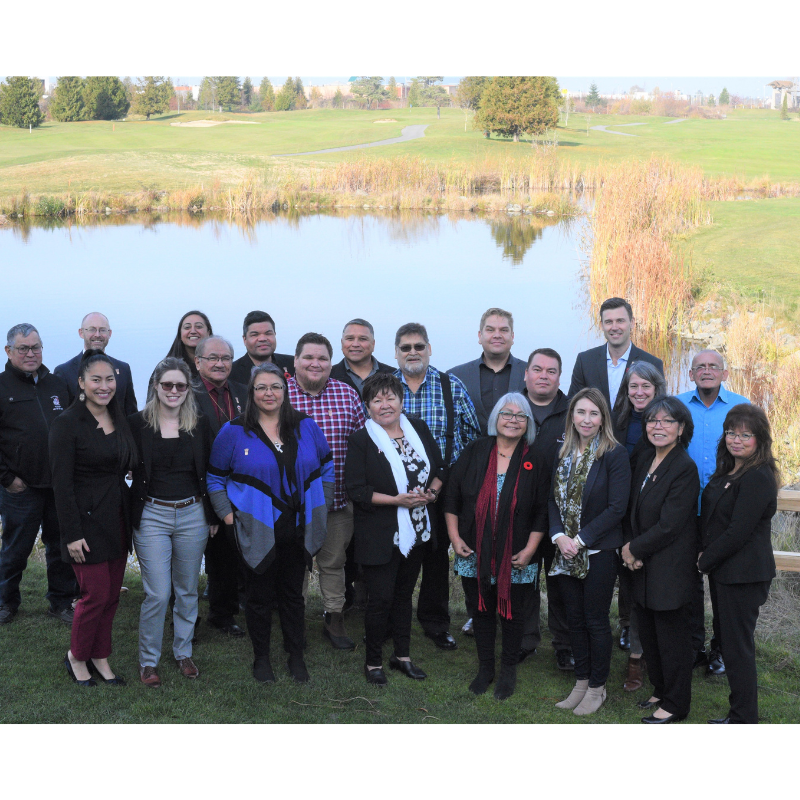
The Alliance of BC Modern Treaty Nations is formed by Tsawwassen First Nation, Tla’amin Nation, Huu-ay-aht First Nations, Ka:’yu:’k’t’h’/Chek’tles7et’h’ First Nations, Toquaht Nation, Uchucklesaht Tribe and Yuułuʔiłʔatḥ Government. Nisg̱a’a Nation joined the Alliance in November 2019.
The federal government announces complete forgiveness and reimbursement of all modern treaty negotiation loans.

2019
2019
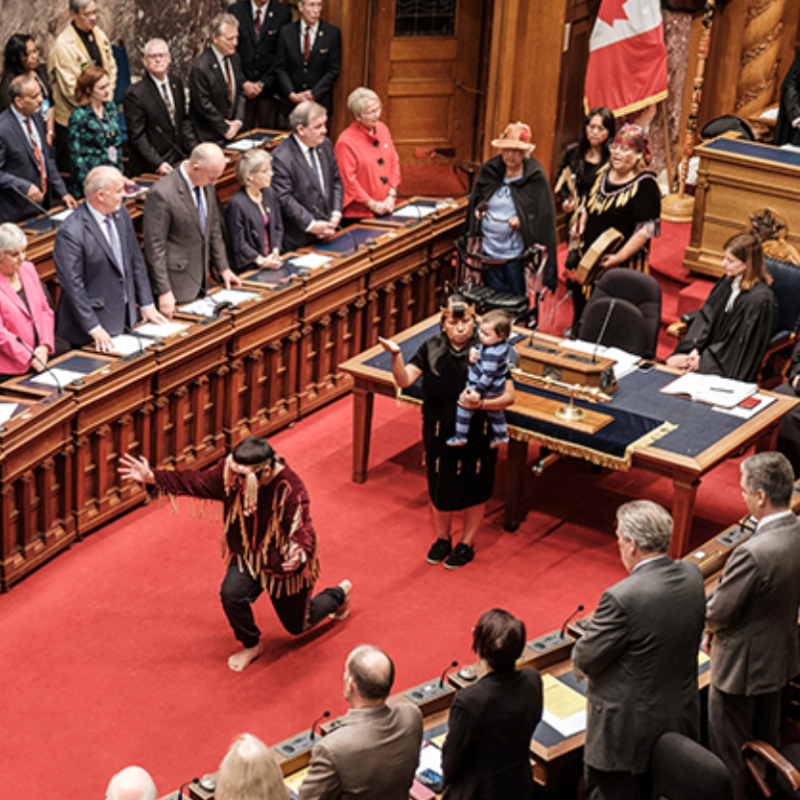
The Province of BC passes the Declaration on the Rights of Indigenous Peoples Act.
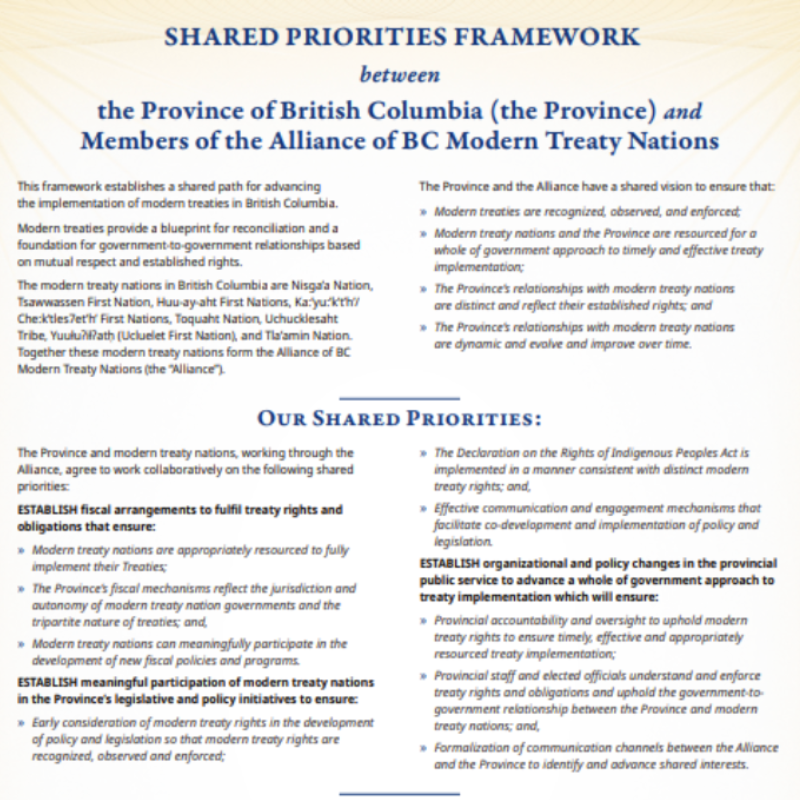
The Shared Priorities Framework is signed by the eight existing Modern Treaty Nations and the Premier of BC, guiding the relationship between the Alliance and the Province of BC.
2022
2023

The Government of Canada passes the United Nations Declaration on the Rights of Indigenous Peoples Act Action Plan.
Nisg̱a’a Nation and the governments of Canada and British Columbia commemorate the 25th anniversary of the Nisg̱a’a Final Agreement (the Nisg̱a’a Treaty).
2025
2026

15-year anniversary of the Maa-nulth Treaty.
The Alliance brings together eight Modern Treaty Nations who collaborate to advance their shared priorities in support of modern treaty implementation. The organization does not speak on behalf of the Nations; instead, it supports them by coordinating work on initiatives of shared interest and by providing space for sharing resources and information. The Alliance works to strengthen relationships with governments and to build public awareness about modern treaties in BC. Through this collaborative structure, where decisions are made by consensus, the Alliance amplifies shared priorities while fully respecting each Nation’s independence and self-governing authority. The Alliance welcomes new members with modern treaties in effect.
Read more: Alliance of BCMTN
Modern treaties in B.C. are comprehensive agreements between First Nations, Canada, and the Province. They define land and resource rights, recognize First Nations as governments with constitutionally protected rights, and limit the authority of the Indian Act, enabling them to establish their own constitutions and exercise law-making powers. These agreements define authority over governance, land, citizenship, and resources. Designed to operate alongside federal and provincial systems, modern treaties provide long-term certainty, strengthen government-to-government relationships, and support social, cultural, and economic well-being for First Nations and all British Columbians.
Modern treaties are constitutionally protected under section 35 of the Constitution Act, 1982, meaning they take precedence over other Canadian laws and cannot be overridden by new legislation. The Supreme Court of Canada has described modern treaties as the pinnacle of reconciliation between Indigenous peoples and the Crown, and the primary tool for reconciliation of prior and unextinguished rights and asserted Crown sovereignty.
Modern Treaty Nations are not “Bands” or “Band Councils,” but self-governing Indigenous governments with their own legislative and executive structures. They exercise authority and jurisdiction over lands, resources, citizenship, and other areas outlined in their treaties, and they no longer operate under the reserve system established by the Indian Act. Instead, Modern Treaty Nations hold Treaty Lands in fee simple. This means the Nation holds full legal title to the land, rather than the land being held by the Crown as it is under the reserve system. The Nation therefore has primary authority to manage how the land is used and developed. Unlike typical fee simple ownership, these lands also include subsurface rights, meaning the Nation has authority over activities on, above, and below the land, including natural resources beneath the surface. Each Nation also has its own laws that define the structure, responsibilities, and composition of its government.
No, Modern Treaty Nations are not all the same. Each modern treaty is negotiated separately and tailored to the unique needs, priorities, and circumstances of the specific Nation(s) involved, reflecting their history, region, and culture. Each Modern Treaty Nation operates under its own agreement, with distinct rights, responsibilities, and governance structures.
Read more: Government of Canada, LCAC
Modern Treaty Nations in B.C. are First Nations that have entered into comprehensive, negotiated agreements with the federal and provincial governments known as modern treaties. These treaties affirm self-government powers, constitutionally protected rights, land ownership, and specific jurisdictions, including citizenship, resource management, and public services. Modern Treaty Nations exercise law-making powers, deliver programs and services to their citizens, and engage with Canada, British Columbia, and other governments on a government-to-government basis. They play an active role in shaping their own futures while contributing to the social, cultural, and economic life of British Columbia.
In contrast, First Nations without a modern treaty do not have these comprehensive agreements and are governed primarily under the Indian Act, which doesn’t provide the same self-government or resource management. While the rights and title of all First Nations continue to exist and are recognized and protected under section 35 of the Constitution Act, 1982, the rights of Modern Treaty Nations are negotiated and set out in their treaties, providing greater certainty about how these rights are exercised.
Read more: History of Treaties in BC, BCTC
There are four modern treaties in effect in B.C. and eight Modern Treaty Nations:
As members of the Alliance of BC Modern Treaty Nations, these Nations collectively advocate for issues related to modern treaty implementation and building effective government-to-government relationships.
Read more: Alliance of BCMTN
Modern treaties establish clearly defined rights and responsibilities for Modern Treaty Nations concerning land ownership, resource management, water, fiscal arrangements, culture and heritage, and governance, and more. They do not extinguish Indigenous rights; rather, they formally recognize and set out how rights will be exercised and implemented.
Treaties are considered “living agreements” with mechanisms for review and renewal as new rights are recognized or circumstances change.
Read more: Province of BC, BCTC
The parties to a modern treaty in B.C. are the Government of Canada, the Province of British Columbia, and the participating First Nation(s). These tripartite agreements are negotiated to recognize Indigenous rights, reconcile pre-existing Indigenous sovereignty with Crown sovereignty, and support self-governance.
Read more: BCTC, Province of BC
Self-government is the inherent right of Indigenous Peoples to govern their own affairs. For a First Nation implementing a modern treaty, this means operating under its own constitution and exercising law-making authority to manage treaty lands and deliver public services such as education, health care, social programs, policing, and cultural preservation. These self-government authorities are negotiated and written directly into the treaty, functioning within the Canadian constitutional framework and alongside federal and provincial laws.
Read more: BCTC FAQs
Each Modern Treaty Nation operates within its own treaty framework, so effective engagement often means adapting your approach to the Nation and its distinct context. When seeking to engage with a Modern Treaty Nation, communicate with them directly. The Alliance of BC Modern Treaty Nations can be copied on communications, but are not the pathway to direct engagement. Visit the About Us page to find more details and direct links to each Nation’s website.